

Paint a rubber snake with white glue, wait a few hours, then peel off a see-through skin that comes away in one piece and turns itself inside out, exactly the way a real snake sheds.
- Ages Ages 10-12, Ages 7-9
- Active time 20 minutes
- Prep 5 minutes
- Grown-ups Grown-up nearby
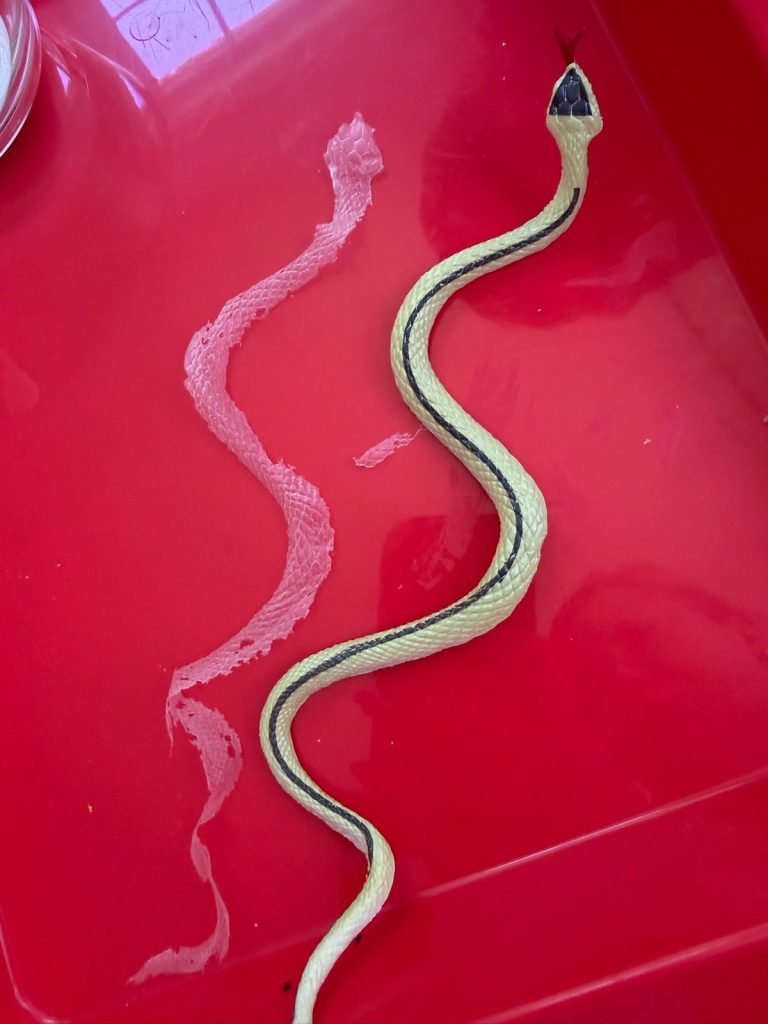
Snakes get rid of their skin all at once, in a single piece, and the piece comes off inside out. In this activity you give a rubber snake a shed skin of its own out of white glue, then peel it off and see how closely it matches the real thing.
Making it takes about twenty minutes, and then it has to dry for a few hours, so plan accordingly 🙂
What you need
Buying through these links costs you nothing extra and helps fund free science education.
Likely have on hand
- White school glue (PVA) 1 bottle, 4 oz or bigger The cheap white kind, which dries clear
- Small bowl or glass 1
- Paintbrush 1 Half an inch to an inch wide. A flat craft brush is ideal.
- Tray or baking sheet 1
- Paper towels a few
Worth ordering
- Rubber toy snakes, multipack 1 pack This is the set in our photos. Twelve 14-inch snakes with deep moulded scales, so everyone gets their own and you can try different glue thicknesses side by sid
- Flat craft brushes, multipack 1 pack Glue ruins brushes eventually, buy cheap.
- Hand lens, 10x 1 For finding the scale prints in the dried glue. Useful in every activity after this one, too.
- Real shed snake skin 1 Optional, and not an Amazon buy. Reptile shops and reptile expos sell real sheds cheaply. Holding one next to your replica would be a unique add.
What you do
-
Put the snake on the tray and pour some glue into the bowl.
Use a tray with a rim.
-
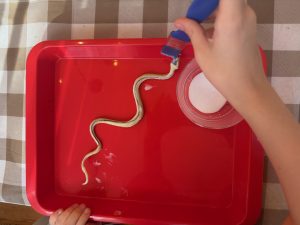
Brush glue along the snake, head to tail. Push it down into the scales rather than laying it on top.
The glue has to reach the bottom of every scale groove to pick up the pattern.
-
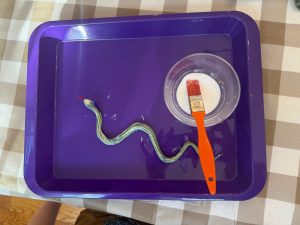
Keep going until the whole top surface is covered in one unbroken layer, about as thick as a dime.
-
Put the tray somewhere flat and out of the way, and wait.
White glue needs up to 4 hours to dry all the way through.
-
Check whether it is ready. The glue should have gone from white to clear, and should not feel cool or tacky anywhere.
If it still feels tacky, there is water left inside and it needs longer.
-
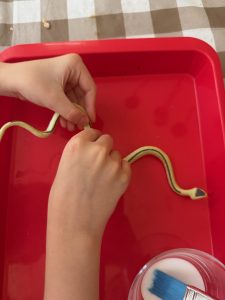
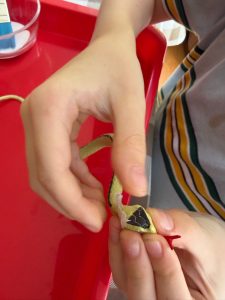
Start at the head. Pinch the glue near the nose and work the edge loose with a fingernail.
Real snakes do this too. They rub their nose against a rock or a branch until the skin around the lips comes loose.
-
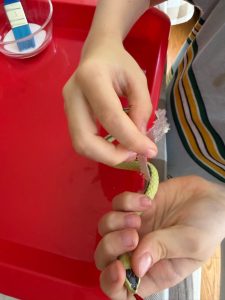
Peel backward down the body, slowly, a little at a time.
Pull quickly and the skin tears, so take your time.
-
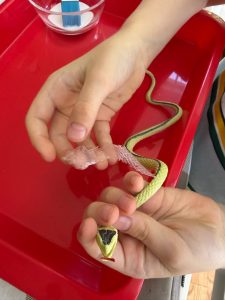
Watch the skin as it comes away. It rolls itself inside out as it goes.
This is easier to see if you stop partway and look at the part that has already come free.
-
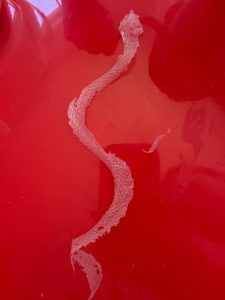
Lay the finished skin next to the snake and find the scales printed in the glue.
A hand lens helps here.
-
Stretch the skin gently between your fingers, then let go. Measure it before and after.
What is going on
A snake's scales are not separate plates stuck onto its body. They are folds in one continuous sheet of skin, made mostly of beta-keratin, the same family of material as your fingernails. Every scale on a snake is connected to every other scale, which is why a shed skin comes off as one piece rather than a pile of flakes.
Your glue skin is built the same way. You brushed on one connected layer, so it peels as one connected layer. If you left a hole in it, that hole is where it tore. Snakes have the same problem: a snake that is dehydrated or unwell sheds in rags instead of one piece, and keepers treat a bad shed as a sign that something is wrong.
Look at which side of your skin carries the scale pattern. It is the inside, the face that was pressed against the rubber. Real shed skins work the same way: a snake crawls forward out of its old skin, the skin peels backward over its body, and it finishes inside out, like pulling off a sock. The outside of a shed skin you find in the woods was the inside surface while the snake was wearing it.
The rubber did a job that snakes do with fluid. Before a snake sheds, it secretes a liquid layer between the old skin and the new one underneath. That layer is what lets the old skin release cleanly instead of sticking. It also fills the space behind the transparent scale that covers each eye, which is why a snake about to shed looks cloudy or blue-eyed and goes nearly blind for a few days. Snakes spend those days hidden.
Snakes also start at the head. A snake loosens the skin around its lips first, usually by rubbing its snout against a rock or a branch, then crawls out through the opening it has made. You did the same thing with a fingernail.
So why shed at all? Keratin does not grow. A snake's outer layer is a fixed size from the moment it hardens, and the snake inside it keeps getting bigger. Shedding is how it gets out of a covering it has outgrown. Young snakes, which grow fastest, shed most often. Adults typically shed three or four times a year.
Your glue skin behaves the same way. Stretch it and it springs back to the size it dried at, however much it bends.
Thanks so much for joining, stay curious!